%201.svg)
Dual Language in Transitional Kindergarten: A Critical Opportunity We Can’t Afford to Miss
Dual Language in Transitional Kindergarten: A Critical Opportunity We Can’t Afford to Miss
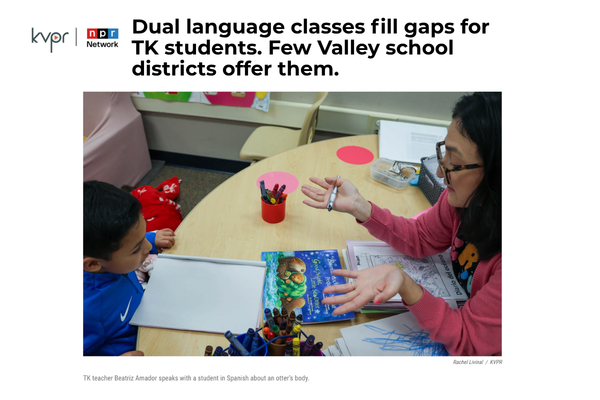
As California completes its historic expansion of Transitional Kindergarten (TK), a recent article from KVPR highlights both a promising strategy and a concerning gap: while Dual Language programs are showing strong potential for young learners, very few districts—especially in the Central Valley—are offering them.
This moment presents a clear opportunity. If TK is meant to serve all children, it must be designed to fully include and uplift Dual Language Learners (DLLs—who make up a significant portion of California’s early learners).
Dual Language Programs Are Filling Critical Gaps
The KVPR article underscores how dual language classrooms are helping young children access learning in ways that traditional English-only settings often cannot.
“Students don’t have to leave their language at the door to learn.”
This approach reflects what we see in practice across SEAL partner districts like Delhi Unified School District, where language is treated as an asset and instruction is intentionally designed to build both academic content and multilingualism from the earliest years.
In TK classrooms, this matters deeply. Children are not only learning foundational literacy and numeracy—they are forming their identities as learners. When their language and culture are affirmed, they show up with confidence, engagement, and a stronger sense of belonging.
The Problem: Access Is Limited
Despite the clear benefits, the article points out a major equity gap:
“Few Valley school districts offer them.”
This gap is especially striking given who TK is meant to serve. Nearly 60% of children birth to age five in California are Dual Language Learners—yet access to programs designed with them in mind remains uneven.
Delhi Unified stands as an important example of what’s possible when systems invest in aligned, language-affirming approaches. Through implementation of SEAL’s model, the district has demonstrated that centering multilingual learners is not only feasible—it leads to stronger outcomes and more coherent instructional systems.
The question is not whether this can be done. It’s why it isn’t happening at scale.
What’s at Stake
The article reinforces that dual language programs are not just beneficial—they are responsive to the realities of California’s classrooms:
“These programs can help meet the needs of students who are still learning English while building early academic skills.”
Organizations like Early Edge California – a long-standing partner in advancing early learning policy – continue to elevate the importance of getting TK right from the start. Their leadership in expanding access and shaping policy has helped bring attention to the urgent need for systems that reflect the strengths and needs of multilingual learners.
This is where practice and policy must work together. We already know what works. The challenge now is ensuring that systems are designed to support and scale it.
A Call for Intentional Design
For Anya Hurwitz, SEAL Executive Director, this moment is about more than expansion—it’s about alignment.
As she emphasizes in the article:
“We have a real opportunity right now to design TK in a way that truly serves multilingual learners from the start.”
This is a critical inflection point. TK is still being built. The decisions being made now about instruction, teacher preparation, and program design will shape outcomes for an entire generation of students.
Moving Forward: From Opportunity to Action
At SEAL, we see this moment as a clear inflection point not just for access, but for how California defines quality in early learning.
We know what works. We see it in classrooms and systems like Delhi Unified School District, where a language-affirming approach is not an add-on, but the foundation of instruction. When multilingual learners are centered from the start, outcomes improve not only in language development, but across academic achievement and engagement.
The opportunity now is to ensure that this is not the exception, but the expectation.
That requires intentional alignment across systems:
• Instructional Design: TK classrooms must be built to develop language and content together grounded in students’ linguistic and cultural assets
• Educator Capacity: Teachers need sustained, practice-based professional learning to deliver high-quality, language-affirming instruction
• Workforce Development: California must invest in and expand a bilingual teacher pipeline that reflects the students we serve
• Policy and Funding Alignment: State and local decisions must prioritize and resource approaches that are proven to support multilingual learners
In partnership with organizations like Early Edge California, we have an opportunity to align practice, policy, and investment in ways that move beyond pilots and pockets of success toward system-wide impact.
As Anya notes, the question is not whether we can design TK to serve multilingual learners, it’s whether we will.
At SEAL, we are committed to ensuring that TK is not only universal in access, but transformational in design so that every multilingual learner enters school with their full identity recognized as a strength and their potential fully supported.
Read More News from SEAL

Learn about changes in policy, up-to-date research, and unique practices to support Dual Language and Multilingual Learners. And don’t forget to sign up for our newsletter here.